
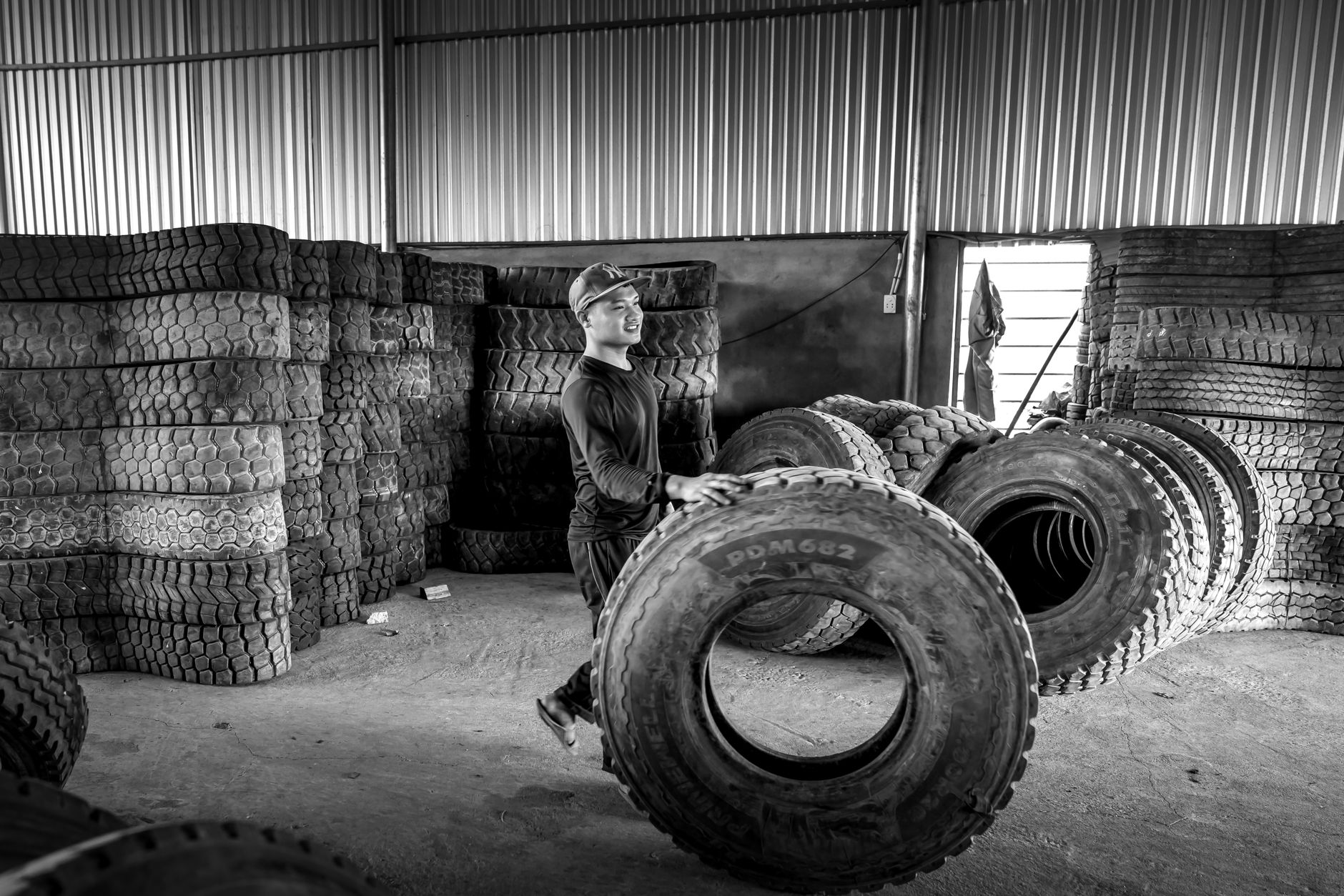
A new tire wears down slowly and evenly, shaving off rubber in a predictable way until it reaches the wear bars. A tire with a mechanical problem wears strangely, in patterns that look deliberate even though nothing deliberate caused them. That difference is a message. Every unusual wear signature is a record of forces acting on the tire that shouldn’t be, and a driver who learns to read those marks can catch a fault long before it shows up as a breakdown or a failed inspection.
Why does uneven wear deserve a closer look than you give it?
Most operators glance at tread depth and nothing else. Depth tells you how much life is left, but it says nothing about why the rubber is leaving. A tire that wears flat and square across its face is doing its job. A tire that wears into ridges, strips, or angled bands is telling you that something upstream—inflation, alignment, suspension, or loading—is off. Catching the pattern early turns an expensive casing loss into a cheap adjustment.
What does feathering across the tread shoulders reveal?
Run your palm sideways across the tread. If the ribs feel smooth in one direction and sharp like the edge of a saw tooth in the other, that’s feathering. It comes from the tire being dragged slightly sideways as it rolls, almost always a toe setting that’s out of spec. On steer tires especially, feathering is the earliest hint of an alignment problem, and it often appears well before the truck starts pulling or the steering feels wrong.
Is cupping or scalloping pointing to a suspension problem?
Cupping shows up as scooped-out dips spaced evenly around the tread, giving the tire a wavy, uneven surface. It usually means the tire isn’t staying in steady contact with the road—it’s bouncing. Worn shock absorbers, loose wheel bearings, or a tire that’s slightly out of balance all let the tread hammer the pavement instead of rolling smoothly over it. Cupping is one of the few patterns you can often hear before you see it, as a droning hum that changes with speed.
What causes that worn strip down the center of the tread?
When the middle of the tread is noticeably more worn than the shoulders, the tire is carrying its load on too narrow a footprint. The classic cause is overinflation: too much pressure bows the center of the tread outward so it bears the brunt of the weight. The fix is rarely the tire itself—it’s the pressure practice behind it.
When both edges wear faster than the middle, what’s wrong?
The opposite pattern—both shoulders worn while the center stays fuller—is the signature of underinflation or of a tire consistently carrying more load than its pressure supports. With too little air, the tire flattens and the edges take the load the center should share. This one is worth taking seriously because the same underinflation chewing the shoulders is also building heat deep in the casing.
Could one-sided wear mean your axle is out of alignment?
When one shoulder wears away while the other stays nearly full, the tire is leaning. Excessive camber, a bent axle, sagged springs, or a shifted axle can all tilt the wheel so one edge drags. One-sided wear is stubborn—replacing the tire without correcting the geometry just feeds a fresh tire into the same grinder.
What do diagonal wear bands warn you about?
Diagonal bands of wear cutting across the tread at an angle are most common on trailer and drive positions. They often trace back to a combination of problems—mismatched tire pressures across an axle, a worn bearing, or an axle that isn’t square to the frame. Because the causes overlap, diagonal wear usually calls for a full inspection of the axle and running gear rather than a single quick fix.
Where should you turn once the pattern is diagnosed?
Reading the pattern is half the job; acting on it is the other half. Once you know whether you’re fighting alignment, suspension, or inflation, you can correct the root cause and then fit the right replacement for the position and duty. Operators in the Québec region often cross-check wear against the specs in a catalogue Pneus Québec to match a casing’s load rating and tread design to the axle it will actually run on, so a corrected fault doesn’t get undone by the wrong tire.
Treads keep an honest record of how a truck is maintained. Operators who learn to read that record early will catch the small faults while they’re still small—and keep more rubber on the road for the miles ahead.