
Most of the damage done to oversized furniture doesn’t happen during the lift. It happens in the three feet before the doorway, when someone is already committed to the weight and discovers the piece won’t clear the frame. By then the muscles are loaded, the fingers are pinched, and the only options left are bad ones. A monster dresser, a sofa bed, or an upright piano punishes planning failures far more than it punishes weak arms. The sequence below is built to catch those failures early, while you can still change your mind.
Step one: measure the item against the doorway, not the other way around
People instinctively measure the doorway first and then eyeball the furniture, which is backwards. Start with the piece. Record its height, width, and depth, and then find its real bottleneck dimension by tilting it on its side in your head. A tall dresser often passes through a door on the diagonal, so the diagonal measurement across its face is the number that matters, not the width printed in the catalog. Only once you know that figure do you go measure every opening on the route. Subtract an inch for knuckles and door hinges. If the gap is tighter than that inch, you’ve learned something important before you ever bend your knees.
Step two: clear the path versus clearing the piece
There are two ways to win an inch, and they cost very different amounts of effort. Clearing the path means removing the obstacle: pop the door off its hinges, take the handrail down, roll up the runner, move the hallway table. Clearing the piece means shrinking the furniture itself: pull out the drawers, unscrew the feet, detach the mirror, fold and strap the sofa mechanism shut. Always exhaust the cheap path-clearing moves first, because taking a door off takes five minutes and partially dismantling an antique armoire can take an hour and leave you with hardware you’ll never match again. Lay the removed parts somewhere outside the route so nobody trips on a drawer mid-carry.
Step three: sliders on hardwood or straps on carpet
How you move the piece across the floor depends entirely on the surface. On hardwood, tile, or laminate, hard-plastic or felt sliders under each foot turn a dead-lift drag into a gentle push, and they spare the finish on both the floor and the furniture. On carpet the sliders fight you, so you switch to lifting straps or a flat moving dolly instead. The one rule that holds across both surfaces: never drag a loaded piece by pulling on a drawer face, a door, or a decorative molding. Those parts were glued and screwed to look good, not to bear the whole weight of the item behind them.
Step four: lifting with legs versus pivoting on a dolly
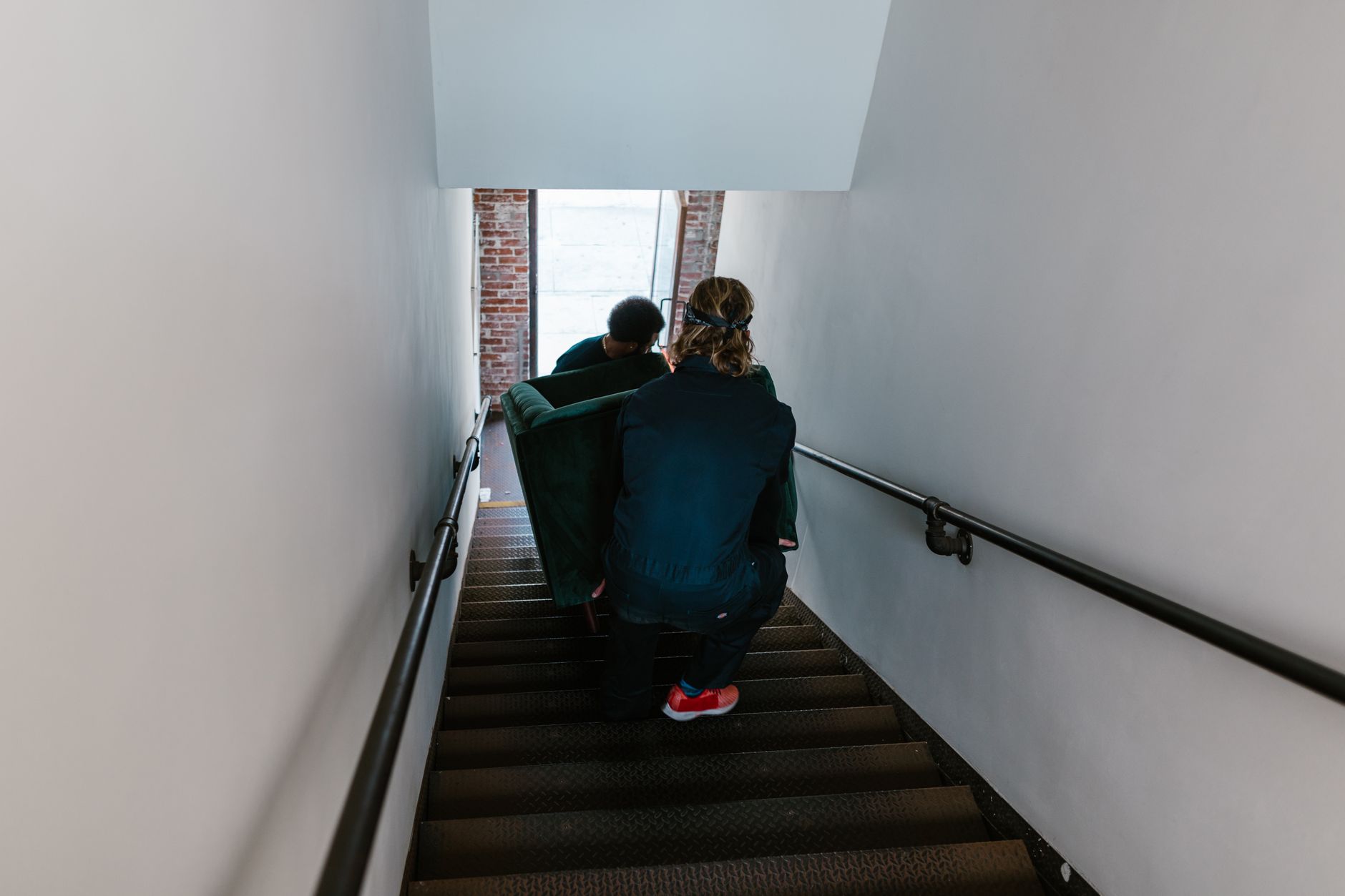
On flat ground, a dolly beats your back every time, so pivot the piece onto it and roll. Stairs are where the real decision lives. Going down a flight, the person below controls the speed and the person above controls the tilt, and you lift with your legs, keeping the load close and your spine straight. The lower carrier takes the heavier share and sets the pace by calling each step aloud. Never let momentum carry the piece down a step on its own; a dresser that starts sliding on a staircase does not stop politely. If the stairwell turns, work out the pivot point on paper before anyone lifts, because a mid-flight rotation with a loaded dresser is the single most dangerous moment in the whole job.
Step five: a two-person carry compared to calling in a crew
Two reasonably fit people can handle a surprising amount on flat routes with straps and a dolly. The line gets crossed when the item is both heavy and must change elevation through a confined space: a piano down curved stairs, a sofa bed into a basement, an armoire around a tight landing. At that point you’re no longer lifting weight, you’re managing a controlled fall, and that wants three or four trained bodies with the right gear. If you’re in that situation and you need help moving heavy furniture, hiring it out costs far less than a wrenched back or a cracked newel post. Be honest about which category your job falls into before, not after, you’ve committed to the stairs.
The moment you feel the load start to control you instead of the other way around, stop. A heavy piece will give you exactly one warning before it stops being a moving problem and starts being an injury.